
Your shop has one real bottleneck. It's you.

Not because you're bad at this. Because in a plumbing shop dispatch, the trucks and the books don't talk, so every answer has to come through you. One record ends that.

1record

Nobody re-types anything

The address your CSR takes at 8am is the one the tech closes, the invoice bills, and payroll pays on.

6→ 1

One place to look

Plumbing software, the fleet tool, and four spreadsheets. Your crew stops asking you which one is right.

0spreadsheets

Month-end stops being an argument

Job costing, commissions, and purchase orders sit on the job itself. There is nothing left to reassemble.

30days

You are never locked in

Month to month, full export whenever you want it. We re-earn it or you leave.

The stack you're running right now

You're paying for six tools that don't talk to each other.

This is the actual stack under a twelve-truck shop. Every line of it is one login now.

What you're running now
Your current plumbing software
Dispatch, the tech app, invoicing
A fleet or DOT compliance tool
Fleet, inspections, maintenance journal
The parts spreadsheet
Inventory, warehouse queue, parts-waiting
The job-costing spreadsheet
Job costing and crew profitability
The commission spreadsheet
Commission rules that run on payment
A shared Google Calendar
Calendar sync and the scheduling grid
The group text thread
Team message board with mentions

That's the real comparison. Not “we're cheaper than ServiceTitan” — it's the other four subscriptions. See what's in it →

All of it is $500 a month plus $25 per user, month to month. See the math →

Three rules we won't break

Neutral software is how owners get burned.

It does whatever it's told. We have opinions, because we learned these running actual trucks.

Rule 01

Chase bookings. Not leads.

A lead is someone who called. A booking is money on the calendar. We track which ads produce work a tech actually shows up to, so you are buying revenue instead of phone calls.

Rule 02

Type it once. It rides to payroll.

The address your CSR takes at 8am is the same record the tech closes, the invoice bills, the commission pays, and QuickBooks books. One job, one entry, all the way through.

Rule 03

Your data walks out with you.

Month to month, full export any time, in formats you can actually open. Software that is hard to leave is not earning your business, it is holding it.

The gap

Four things they can't just add.

Anyone can ship a dispatch board. These took either a decade in the trade or a decision nobody else is willing to make.

Trade focus01

We only do plumbing, drain, and sewer.

Jobber runs landscaping, cleaning, and HVAC out of the same product. Serving five trades means every plumbing-specific thing competes with four other roadmaps for the same engineer. Matching us here is not a feature they can ship. It is revenue they would have to walk away from.

Housecall Pro, Workiz, and Jobber all serve multiple trades.
Trucks02

The fleet tool is already in the box.

DOT inspections, a maintenance journal, fuel capture, and a mechanic portal, included. The others reach fleet through a third-party telematics partner and bill it per vehicle on top of your seats. Buying it is not the same as it being in the product.

Housecall Pro and Jobber add fleet via third-party partners, billed per vehicle.

Franchise03

Built for a network, not upgraded into one.

Six roles isolated per location, a cross-org view over every franchise at once, and self-serve provisioning that stands up location five without a project. Multi-location was the shape of the product on day one because our own first customer runs four. Bolting that onto a single-business schema later is a rewrite, not a release.

Multi-location is an upgrade path for the others, not the shape.

Revenue line04

Water-heater leases actually run in here.

A lease and sale toggle, real lease agreements, and the recurring billing underneath them. Shops that lease equipment currently keep that revenue in a spreadsheet because their software has nowhere to put it. Recurring obligations reach into billing, invoicing, and the customer record at once, which is why nobody bolts it on.

Equipment leasing is absent from all three comparison sets.

Four locations run on it every day. Open the same product they use, with real data in it.

How it works

From phone call to paid. In one screen.

No tab-hopping, no re-typing the customer's address into four systems. One panel, the whole job.

01

Intake

Backed-up drain call comes in. Branded intake form, zone-aware, rate-limited. The CSR captures it once.

02

Dispatch

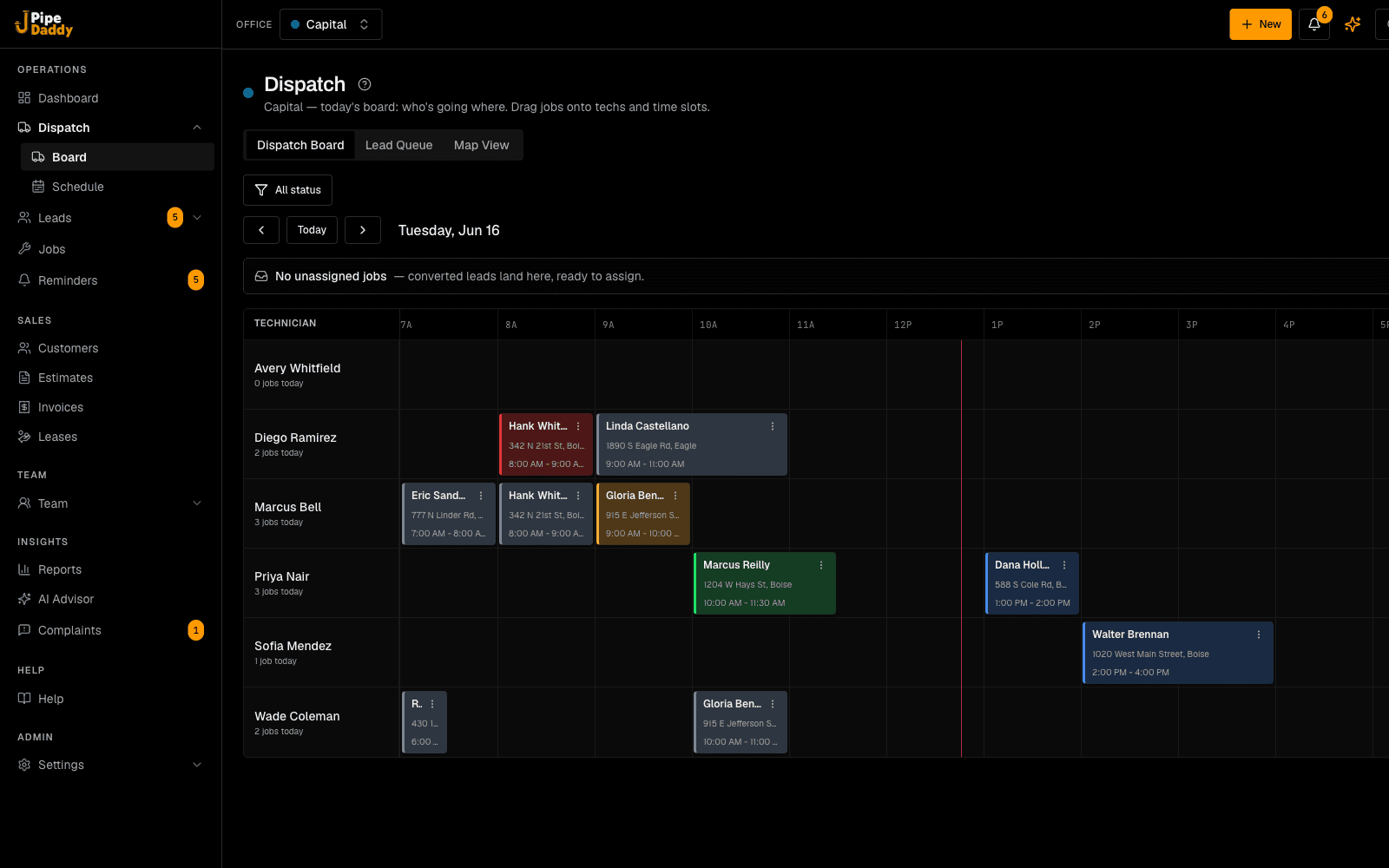
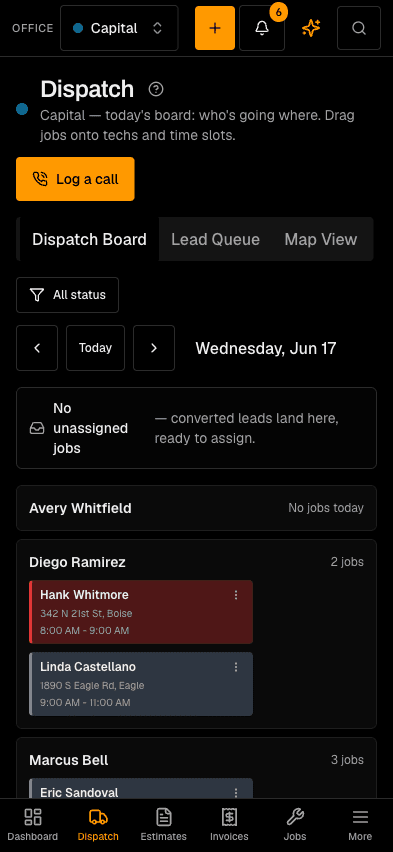
Drag to a truck. Horizontal board, techs as rows, live pins on the map.

03

Field

Tech runs it. GPS auto-advance, price book on the phone, card payment taken on the job.

04

Paid

Invoice closes, commission calculates itself, QuickBooks and Gusto stay in sync.

What it actually does

The parts that keep a plumbing shop owner up at night.

Nobody lies awake wanting a commissions engine. Six of the 31 things this runs, in the words owners actually use.

“Somebody called at 7am and nobody called them back till noon.”

Speed-to-lead alerting

A new lead raises an alert until a human owns it. First responder wins the job, so the clock is the product.

“Half my jobs are in basements with no service.”

Works with no signal

The app runs from a cached shell and queues every change on the device. It shows what's pending and syncs itself when the bars come back.

“I don't know which jobs actually made money.”

Job costing and crew profitability

Labour, parts, and drive time land against the job, so you find out which work and which crews are worth it — including surge pay.

“I found out about the DOT inspection when it was already overdue.”

Fleet and DOT compliance

Vehicle inspections, a maintenance journal, fuel capture, and a mechanic portal. This is the separate fleet tool you're paying for.

“I can't run water-heater leases in my software at all.”

Lease and sale, with recurring obligations

A lease/sale toggle, real lease agreements, and the recurring billing behind them. Most plumbing software simply can't do this.

“My CSR types every work order in by hand.”

AI work-order intake parsing

The request arrives as text and comes out as a structured job. This is the most modern thing we've built and the site has never mentioned it.

The other 25, across six areas →

20 of them this site spent a year not mentioning

Built by plumbers

Pipe Daddy wasn't dreamed up by a software company and sold to plumbers. It was created by plumbers.

It came out of one of Roto-Rooter's oldest franchises — a Pocatello, Idaho shop that's been running trucks, dispatching techs, and answering 2am calls since 1956. Brandon Hepworth and his team had lived every problem this industry deals with: dispatch chaos, fleet costs bleeding margin, house-call math that never adds up, software that was clearly built by people who'd never ridden in a service truck.

So they stopped waiting for someone to fix it and built the answer themselves — a platform designed around the actual issues, objections, and daily headaches that every Roto-Rooter franchise and most plumbing companies face today.

That's why Pipe Daddy works the way your shop works. It wasn't guessed at. It was pressure-tested inside a real franchise, by a real crew, on real routes — before it ever touched yours.

They made it work for their shop. Now it works for yours.

Proof

Built inside a working Roto-Rooter franchise, one job at a time, until it ran the whole operation.

No invented percentages. Real numbers land here with the shop's name on them.

4
Locations running it in production

Not a pilot tenant. A working Roto-Rooter franchise.

6
Roles per location, fully isolated

Owner, dispatcher, CSR, tech, bookkeeper, field admin.

31
Capabilities verified against the live build

Audited feature by feature, not counted off a roadmap.

You have seen who built it and what it runs. The rest is easier to judge from inside.

Switching

Switching software is terrifying. We make it not.

Nobody rips out the system their business runs on for a promise. So here is the move, exactly.

  • We move your data. You don't re-key a thing.
  • Run Pipe Daddy alongside your old system until you trust it.
  • We train your dispatchers and techs, live, on your real jobs.
  • Go at your pace. One location first if you want.
The product

Everything your plumbing franchise runs on. In one screen.

The Pipe Daddy dispatch board — techs as rows, jobs in time slots
01 — Dispatch

Horizontal board, techs as rows, jobs in cells. Drag to move. Live truck pins on the map.

Public Lead Intake

Branded forms, zone-aware, rate-limited.

Recurring Reminders

Annual sewer cleans, water heaters, septic.

Multi-Location Roles

6 roles per location, fully isolated — no data bleed.

QuickBooks + Gusto Sync

Native, not "compatible".

02 — In the truck

What the tech sees.

GPS auto-advances status. Price book built in. Card payment taken on the job, on your own Stripe account.

03 — The back office

Money moves on its own.

Commissions accrue on payment. AI Advisor answers questions about your data in plain English.

The tech app, the money engine and every other area, screen by screen, live on the product pages.

Pricing

Priced for this decade. No annual handcuffs.

$500 a month plus $25 a user, month-to-month. Cancel whenever. The low price isn't the pitch. The lack of a leash is.

Pipe Daddy

$500 / month + $25 per user

10 users = $500 + $250 = $750/mo

Monthly, cancel anytimeDispatch, field, back office all inData migration includedBuilt 2026, on your side
Live in a Roto-Rooter franchise

Open it and see whether it's worth a conversation.

No form, no salesperson, real data. It's the same product running four Roto-Rooter locations today.